


 Loading... Please wait...

Categories
Categories
Brands
Brands
- Home
- Tips and Tricks
Tips and Tricks
Helpful Suggestions to Lock Pick Sucessfully!
|
Here are a few tips that can increase your chance of success in picking pin tumbler or wafer locks. Lubricate the plug generously with WD40 or any other approved spray. Do NOT use graphite. Spend a few seconds raking the tumblers with a rake pick to distribute the lubricant. This step alone can make the difference between success and failure, especially if you are working on locks that have been exposed to weather or high levels of dust and grit. One near microscopic particle clinging to a tumbler at the wrong place can nix your chances of picking the lock. Ask questions. You'd be surprised how many times I've wasted time trying to pick a lock that my customer eventually reveals has not been working for some time even with the proper key. As you know, if the lock is not functioning well, it isn't going to pick. However . . . Don't bet the farm on the customer's answer. This applies mainly to turning direction. I used to ask which direction the key is turned to unlock the cylinder (this is usually a constant -- for instance, Kwikset knobsets always pick to the left to unlock, which is backwards of most other brands -- but you may not remember which direction a particular brand picks, and some major brands such as Schlage have models that pick opposite of other models). I realize now that most people pay no attention to which direction is correct and when they stop to think about it they'll come up with the wrong conclusion at least half the time. Use a tension tool that fits the keyway snugly. Always begin with very light turning tension. Don't start resorting to higher forces until you've spent a few minutes raking the lock with feather light turning force. If using a pickgun, start with light tension on the adjustment knob. Too heavy a tension can generate enough force to weaken drive springs in the lock, making the job even harder. When picking locks with miniature keyways, such as is the case with mailbox cylinders and file cabinet locks, it can be hard to come up with a tension tool small enough to do the job without crowding the keyway. You can make a miniature turning tool by bending a small paper clip. Straighten it out and then form a 90 degree bend at one end. Double back on the bend to form a tiny loop that will work as the turning leg. Experiment with the final form until you have a tool that will work with the particular plug you are picking.
The hardest lesson I've had to learn over the years as an Emergency Mobile Locksmith, who does his share of lock picking jobs, is to accept the simple fact that I'm not always going to be successful at picking, and that it's nothing to take personally. Some locks just won't pick. You may not realize it, but locks have personalities. Some of them are just hateful. Some are moody. You might pick a lock easily one day and have no luck at all a week later. Okay, I guess the lock is just a lock. But factors come into play that you don't always have control over. You, for one. Your attitude and your mood, your level of self assurance, your health and your physical stamina . . . all these factors DO affect how much success you'll have on any given lockpick. Not always to the same degree, and there are, of course, locks that are so minimally secure that you might not even notice a change from one day to the next. But when you deal with locks of tighter tolerances (higher security due to better manufacturing and design), ALL these factors as well as others that have nothing to do with you will come into play. Some of those other factors are:The condition of the lock. If tumblers are weak due to a lot of use, it affects how well they'll respond to picking. Also, a dirty keyway can completely nix your chances of picking. The temperature. On a very cold day, springs react differently to your picking than on a warmer day. The position of the lock. This is a big one. Picking a lock that was inadvertently or intentionally mounted upside down can be one heck of job. Makes you want to stand on your head. The best bet is to get in some practice now and then on upside down locks, because it's a whole new ball game. If the lock WON'T pick, you can resort to a couple of strategies: Try shimming the door, if you're picking a knobset. This, obviously, is not an option when picking deadbolts. "Credit carding" a lock doesn't look particularly professional, so use a shim made of stainless steel, or a flat piece of plastic that is unmarked. Once in a while, you'll be forced to either admit defeat or pull out the drill motor. Your customer may not want you to go to this extreme, so get his or her permission. Drilling a lock plug is straightforward and possible in most cases. Next issue, I'll tackle that one with some tips to make it easier. |
CAR OPENING TIPS
This vehicle, in most of its models, has a little booby trap just for locksmiths who like to use under-the-glass tools . . . which is probably the best way to open the models with fully framed window glass. The trap is not an intentional one . . . it exists simply as a window roller that happens to like to trap underglass tools. Once trapped, it's darned near impossible to free the tool without removing the door panel and fishing it out by hand from the inside (which you can't do until you get the car opened!) Here is a way to use underglass tools with these cars, but you must use a narrow one (the U portion of the tool must be of the narrow type), and you must be diligent, using a light to watch for that roller which appears as a "button" mounted just below the level of the door sill, right into the glass of the window. Keep the tool to the REAR of this little obstruction . . . meaning toward the rear of the car as opposed to toward the front . . . and you should be able to raise it up into the passenger compartment without looping over the top of this nasty roller. Many Lexus vehicles have unframed window glass. The right way into these models is to use a shim between the glass and frame of the car, up near the top rear corner of the window. A perfect tool for this is the AIR WEDGE. Wedging a space carefully, you can insert any long rod with a short "L" at the end, which should be wrapped with tape to prevent leaving a scratch on the plastic rocker button that unlocks the door. Keep in mind that Lexus uses a relocker system. This means that the door will relock within a fraction of a second when an opening is made without a key. You get by this by grasping the outside door handle with one hand while you direct the long rod with your other hand. Hook the short "L" at the end of the rod on the rocker switch and prepare to pull on the outside handle at the same instant you maneuver the rocker switch backward, toward you. If you don't catch the relocker, you can keep trying until you get the timing right. The alarm will sound and continue for a while, or until you get the door open and then reset the alarm with the customer's key in the door lock. Bottom line: Lexus can be a bear, but can also be opened as easily as any other vehicle if the right technique is used. I've had to pull the door panel on a couple of these cars because I got careless in using an underglass tool. I now greatly prefer the window wedge method when it is possible!
I always tell my trainees that the first thing you must do as you approach a locked vehicle is -- check to see if it's locked! There's no better way to feel stupid than to spend anywhere from five minutes to half an hour (on some very difficult cars) trying to open it with tools only to find that there was a door that had been left unlocked. At least once a month I get a call to open a locked car that isn't. People get frustrated sometimes and fail to check all the doors before calling. But let's say the car is really locked. How many options do you have? That's the second thing that must be determined, before you pull out a single tool, at least until you start forming regular procedures with most vehicles where you don't even have to think about which tool or procedure will work best. While only a few of the following procedures are valid with any one vehicle (and in some cases, only ONE of the following will pertain), it is very helpful to be aware of all the ways open to you. The smart thing is to choose the least invasive method and try that one first, then move along until you've exhausted all the possibilities (which will leave, in most cases, the final choice which is not, as you might think, a large hammer.) Listed roughly in order of "invasiveness", here are the generally accepted methods of opening locked vehicles when a key is not available.
As mentioned, it's your first job to determine which of these procedures best suits the job facing you, and to select the LEAST invasive of them. You cannot have too many car opening tools. Do yourself a favor and start out with a decent 'starter kit' such as the very popular AK04 from ProLok. Once you've gotten established, add to the kit by picking up a more extensive collection. You might consider the AKLM00 Late Model Car Opening Kit. It has tools in the set that are designed for some of the very difficult vehicles found on the road today. All content by
Lock Pickers Mall |
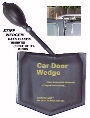 (BUY ONE! You'll be happy you did) and shim an opening between door and door frame (or frameless window and door frame), which allows the use of any one of several tools to enter the passenger compartment and unlock the car or even retrieve car keys from the seat.